
Volkswagen Tiguan vs Toyota RAV4: Which SUV Is Better?

The Volkswagen Tiguan vs Toyota RAV4 comparison has become much more interesting than it used to be. These two compact SUVs approach the same problem from completely different directions. The Toyota RAV4 has built its reputation around efficiency, practicality, and dependable everyday transportation, while the Volkswagen Tiguan leans toward European road manners, interior refinement, turbocharged performance, and a slightly more premium personality.
And now the gap between them has shifted again.
For 2026, Toyota has moved the RAV4 into a new generation built entirely around electrified powertrains, while Volkswagen's redesigned Tiguan brings improved technology, stronger performance, and considerably more power in its upper trim. The standard 2026 Tiguan uses a 201-horsepower turbocharged 2.0-liter engine, while its SEL R-Line Turbo reaches 268 horsepower and 258 lb-ft of torque.
The 2026 Toyota RAV4, meanwhile, uses a hybrid powertrain producing up to 236 horsepower in Canadian specification, with plug-in hybrid models offering substantially more performance.
So, which one should we actually buy?
Let's put the spec-sheet rivalry aside for a moment and look at these SUVs the way owners will experience them: commuting, carrying groceries, taking vacations, overtaking traffic, paying for fuel, and living with them for years.
- Volkswagen Tiguan vs Toyota RAV4 at a Glance
- Volkswagen Tiguan vs Toyota RAV4 Exterior Design
- Volkswagen Tiguan vs Toyota RAV4 Dimensions
- Volkswagen Tiguan vs Toyota RAV4 Interior
- Volkswagen Tiguan vs Toyota RAV4 Technology
- Volkswagen Tiguan vs Toyota RAV4 Passenger Space
- Volkswagen Tiguan vs Toyota RAV4 Cargo Space
- Volkswagen Tiguan vs Toyota RAV4 Engine Performance
- Volkswagen Tiguan vs Toyota RAV4 Driving Experience
- Volkswagen Tiguan vs Toyota RAV4 Fuel Economy
- Volkswagen Tiguan vs Toyota RAV4 Hybrid Options
- Volkswagen Tiguan vs Toyota RAV4 Towing Capacity
- Volkswagen Tiguan vs Toyota RAV4 AWD
- Volkswagen Tiguan vs Toyota RAV4 Safety
- Volkswagen Tiguan vs Toyota RAV4 Reliability
- Volkswagen Tiguan vs Toyota RAV4 Maintenance Costs
- Volkswagen Tiguan vs Toyota RAV4 Comfort
- Volkswagen Tiguan vs Toyota RAV4 for City Driving
- Volkswagen Tiguan vs Toyota RAV4 Price and Value
- Volkswagen Tiguan Pros and Cons
- Toyota RAV4 Pros and Cons
- Who Should Buy the Volkswagen Tiguan?
- Who Should Buy the Toyota RAV4?
- Volkswagen Tiguan vs Toyota RAV4: Which One Should We Choose?
- Conclusion: Tiguan or RAV4?
- Frequently Asked Questions
Volkswagen Tiguan vs Toyota RAV4 at a Glance
At their core, both vehicles are five-passenger compact SUVs designed for buyers who want more room than a sedan without stepping into a bulky three-row vehicle.
Their personalities, however, are surprisingly different.
| Category | Volkswagen Tiguan | Toyota RAV4 |
|---|---|---|
| Driving character | Refined and European | Smooth and efficiency-focused |
| Standard powertrain character | Turbocharged gasoline | Hybrid |
| Maximum available power | 268 hp on SEL R-Line Turbo | Higher-output PHEV available |
| Fuel economy emphasis | Moderate | Excellent |
| Interior feel | Premium and minimalist | Practical and rugged |
| Technology | Strong | Strong |
| Cargo practicality | Excellent | Excellent |
| Highway performance | Tiguan advantage | Strong |
| City efficiency | Good | RAV4 advantage |
| Towing potential | Depends on configuration | Up to 3,500 lb on some versions |
| Best suited for | Driving comfort and refinement | Efficiency and practicality |
There isn't a universally better SUV here. Instead, we're choosing between two philosophies.
The Tiguan feels like Volkswagen asked, "How can we make the family crossover feel a little more sophisticated?"
Toyota seems to have asked, "How can we make the family crossover waste as little fuel and effort as possible?"
Both are sensible questions.
Volkswagen Tiguan vs Toyota RAV4 Exterior Design
Styling is subjective, but the visual personalities of these SUVs tell us quite a bit about their intentions.
The Tiguan has traditionally leaned toward clean surfaces, restrained lines, and a European look. Volkswagen doesn't usually throw twenty different styling ideas onto the same body. The new Tiguan continues that philosophy with a more modern, smoother appearance.
The RAV4 goes in another direction.
Toyota gives it a tougher, more adventurous stance. Depending on trim, the RAV4 can look surprisingly rugged for something that will probably spend most of its life driving between supermarkets, offices, schools, and suburban garages.
Neither approach is wrong.
The Tiguan Looks More Upscale
If our idea of an attractive crossover involves something understated rather than aggressive, the Tiguan makes a strong case.
Its proportions feel tidy, its body looks planted, and its design could easily pass for something positioned slightly above mainstream territory.
That's one of Volkswagen's traditional strengths.
The Tiguan often feels like the person who arrived at dinner wearing a perfectly fitted jacket without making a big deal about it.
The RAV4 Looks More Adventurous
The Toyota has more visual theater.
Especially in rugged-oriented versions such as the Woodland, the RAV4 embraces roof rails, stronger body cladding, distinctive wheels, and outdoor-inspired styling. Toyota lists features such as all-terrain wheels, bridge-style roof rails, LED fog lamps, and rugged exterior elements on the 2026 Woodland.
If we want our SUV to look ready for a camping trip even when we're heading to Costco, the RAV4 fits the brief nicely.
Volkswagen Tiguan vs Toyota RAV4 Dimensions
The Tiguan remains firmly within the compact SUV category, but it's a reasonably substantial vehicle.
Volkswagen Canada lists the 2026 Tiguan at approximately 4,684 mm long, 1,853 mm wide, and 1,688 mm tall, with a 2,791-mm wheelbase.
Those dimensions help create one of the Tiguan's biggest strengths: passenger space.
The RAV4 follows the classic compact-crossover formula as well, keeping exterior dimensions manageable enough for urban driving while providing significantly more practicality than a compact sedan.
Which SUV Is Easier to Drive Around Town?
Neither should intimidate anyone accustomed to modern crossovers.
The RAV4's upright shape can make it feel easy to position, while the Tiguan's balanced proportions work well in city traffic.
Parking sensors, cameras, driver-assistance features, and available surround-view technology can reduce much of the stress anyway.
The difference becomes more noticeable from inside.
The Tiguan tends to create a more car-like impression behind the wheel. The RAV4 feels slightly more SUV-like, with its rugged styling reinforcing that perception.
Volkswagen Tiguan vs Toyota RAV4 Interior
This may be the category where buyers form their strongest emotional preference.
Sit inside both, and the design philosophies quickly reveal themselves.
Volkswagen favors minimalism.
Toyota favors functionality.
Tiguan Interior Quality
The Tiguan's cabin tries harder to create a premium atmosphere.
The dashboard looks modern, displays play a prominent role, and the overall environment feels closer to what we'd expect from a European vehicle.
That doesn't automatically mean every material is luxurious. Mainstream SUVs still need to hit mainstream prices.
But the overall presentation can make the Volkswagen feel more expensive than it actually is.
A Cabin for Minimalists
If we're fans of clean dashboards, digital interfaces, subtle ambient lighting, and fewer chunky physical elements, the Tiguan's approach is appealing.
There is a trade-off.
Highly digital cabins can sometimes require more interaction with touchscreens than traditional dashboards. Some drivers love the futuristic simplicity; others would happily trade half the screen menus for a couple more physical knobs.
Toyota RAV4 Interior Quality
Toyota tends to prioritize usability.
The RAV4 interior isn't trying quite as hard to imitate a luxury SUV. Instead, it feels designed for people who actually use their vehicles aggressively: backpacks thrown in the rear, coffee cups everywhere, kids climbing aboard, groceries rolling around, hiking equipment in the cargo area.
And there's something refreshing about that.
The RAV4 cabin feels like a good pair of hiking boots. The Tiguan feels more like polished sneakers.
We wouldn't wear the same pair for everything.
You might be interested in this content.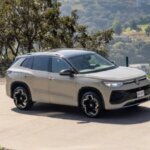 Volkswagen Tiguan vs Honda CR-V: Which SUV Should We Buy?
Volkswagen Tiguan vs Toyota RAV4 Technology
Technology has become one of the main battlegrounds in the compact-SUV segment.
Gone are the days when a basic Bluetooth connection qualified as impressive.
Both SUVs now offer the kind of digital equipment that would have been luxury-car territory not long ago.
Toyota equips the 2026 RAV4 with a standard 10.5-inch multimedia touchscreen in Canada, with an available 12.9-inch display.
Volkswagen likewise places considerable emphasis on large displays and connected cabin technology in the latest Tiguan.
Which Infotainment System Is Better?
This comes down partly to preference.
Volkswagen's system generally creates the more visually dramatic dashboard experience. Toyota tends to prioritize straightforward usability and integrates its multimedia technology without completely redefining the cabin around it.
For tech enthusiasts, the VW may initially produce the bigger "wow."
For someone who simply wants to get inside, connect a phone, start navigation, and drive, Toyota's philosophy may feel more natural.
Volkswagen Tiguan vs Toyota RAV4 Passenger Space
Both SUVs work well for small families, couples, commuters, and road-trip travelers.
The Tiguan's long wheelbase gives it generous passenger accommodations, particularly in the second row.
Adults can comfortably occupy the rear seats without feeling as though they've been sentenced to the cheap seats.
The RAV4 is also spacious enough for everyday family duties. Its upright roofline and practical door openings help passengers get in and out easily.
Which Is Better for Families?
It's close.
Families who prioritize rear-seat comfort and cabin ambiance may lean toward the Tiguan.
Families obsessed with fuel efficiency, durable practicality, and day-to-day simplicity may lean toward the RAV4.
Parents know that luxurious stitching becomes surprisingly irrelevant when someone spills a chocolate milkshake across the back seat.
Practicality has its own kind of luxury.
Volkswagen Tiguan vs Toyota RAV4 Cargo Space
Cargo capacity matters more than many horsepower figures because owners use it almost every day.
Volkswagen advertises up to 69.8 cubic feet of cargo space with the Tiguan's rear seats folded in the U.S. market.
That's enough room for luggage, bicycles with some preparation, home-improvement supplies, camping gear, or a frighteningly ambitious IKEA trip.
The RAV4 is similarly built around practical cargo use.
Its squared-off rear design makes the available space particularly useful. Sometimes the shape of a cargo hold matters as much as the official capacity figure.
A cavernous area with an awkward opening can be less helpful than a slightly smaller but boxier space.
Which Has the More Useful Trunk?
For most owners, either will be excellent.
We'd give the RAV4 a slight conceptual advantage for rugged everyday practicality, while the Tiguan scores points for combining strong capacity with a more polished passenger environment.
Unless we're regularly filling the cargo area to the ceiling, the difference probably shouldn't decide the entire purchase.
Volkswagen Tiguan vs Toyota RAV4 Engine Performance
Now things get interesting.
The Tiguan and RAV4 no longer follow remotely similar powertrain strategies.
Volkswagen remains committed to turbocharged gasoline power in the Tiguan.
Toyota has moved heavily toward electrification.
Volkswagen Tiguan Engine
The mainstream 2026 Tiguan uses a turbocharged 2.0-liter four-cylinder producing 201 horsepower.
Move up to the SEL R-Line Turbo in the United States—or the corresponding Highline Turbo R-Line configuration in Canada—and output increases dramatically to 268 horsepower and 258 lb-ft of torque.
That's a substantial jump.
The high-output Tiguan isn't merely a cosmetic sport package with aggressive wheels and a hopeful badge. There's actual additional muscle underneath.
Press the accelerator and the difference should be obvious.
Toyota RAV4 Hybrid Engine
Toyota takes the opposite route.
The 2026 RAV4 is centered around a 2.5-liter gasoline-electric hybrid system. Canadian specifications list 236 net horsepower for regular hybrid versions.
That places the normal RAV4 comfortably above the regular Tiguan in total stated horsepower, although the delivery of that power feels different because one uses hybrid assistance and the other relies on turbocharging.
RAV4 Plug-in Hybrid Performance
Want more?
The RAV4 plug-in hybrid becomes a different animal.
Toyota Canada lists the 2026 plug-in hybrid at up to 324 horsepower, with a 22.7-kWh battery and substantial electric-only driving capability.
So while the performance-oriented Tiguan is quick by compact-SUV standards, the fastest RAV4 configuration has serious power of its own.
Volkswagen Tiguan vs Toyota RAV4 Driving Experience
Numbers only tell half the story.
The Tiguan's greatest dynamic strength isn't necessarily acceleration.
It's the way Volkswagen tunes the entire vehicle.
Steering, suspension response, body control, seating position, and highway composure work together to create that familiar Germanic sense of solidity.
The Tiguan Feels More European
On winding roads, the Tiguan is likely to be the vehicle enthusiasts prefer.
It feels less like an appliance and more like something Volkswagen actually expects us to enjoy driving.
You might be interested in this content.Volkswagen Tiguan vs Touareg: Which Volkswagen SUV Is Right for You?That distinction matters if our daily commute includes interesting roads rather than endless straight highways.
The Tiguan's turbocharged torque also fits highway driving beautifully. Need to merge? Press the accelerator and the engine responds with the sort of midrange shove turbo engines do so well.
The RAV4 Is Built for Effortless Driving
The Toyota takes a different route.
Hybrid assistance makes stop-and-go driving particularly natural. Low-speed response is immediate, traffic becomes less wasteful, and the vehicle constantly works behind the scenes to reduce fuel consumption.
It may not feel as eager to dance through corners, but how often are we really attacking an apex on the school run?
Exactly.
For ordinary drivers, effortless efficiency can be more valuable than sharper handling.
Volkswagen Tiguan vs Toyota RAV4 Fuel Economy
This is where Toyota lands one of its hardest punches.
The 2026 RAV4's hybrid-only strategy means excellent fuel efficiency isn't reserved for one obscure economy trim.
It's baked into the vehicle's identity.
Toyota Canada lists the RAV4 XLE at approximately 5.2 L/100 km city and 6.1 L/100 km highway, although figures vary by configuration.
Those are impressive numbers for a useful family SUV.
Volkswagen's Tiguan can't fully replicate the hybrid advantage.
Even the powerful Tiguan SEL R-Line Turbo, however, is rated by Volkswagen at an EPA-estimated 29 highway mpg in U.S. specification.
That's respectable considering its 268 horsepower.
Which Will Cost Less to Fuel?
The RAV4 should be the obvious choice for fuel-conscious drivers.
If we commute through heavy traffic every day, the advantage becomes even more meaningful because hybrid systems thrive in low-speed conditions where conventional gasoline vehicles are least efficient.
The Tiguan counters with driving personality rather than outright fuel savings.
Think of it this way:
The Toyota keeps asking, "How little fuel can we use?"
The Volkswagen keeps asking, "How pleasant can we make the drive?"
Volkswagen Tiguan vs Toyota RAV4 Hybrid Options
This category is easy.
Toyota wins.
Volkswagen does not currently position the North American Tiguan around a hybrid powertrain, whereas electrification has become central to the RAV4 lineup.
For drivers specifically searching for a Tiguan vs RAV4 hybrid comparison, the Toyota's advantage is impossible to ignore.
RAV4 Plug-in Hybrid Electric Range
Toyota Canada lists up to 89 km of estimated electric driving range for certain 2026 RAV4 Plug-in Hybrid specifications.
That's enough to fundamentally change how some owners use the vehicle.
Someone with a relatively short commute and reliable home charging could complete many ordinary weekday journeys without using much gasoline at all.
Then, when a long-distance road trip arrives, there's still a gasoline engine available.
It's an attractive compromise for buyers who aren't ready to commit to a fully electric vehicle.
Volkswagen Tiguan vs Toyota RAV4 Towing Capacity
Compact SUVs aren't pickup trucks, but towing still matters for campers, small trailers, bicycles, recreational equipment, and weekend toys.
Toyota advertises towing capacity of up to 3,500 pounds on certain 2026 RAV4 configurations in Canada.
That's genuinely useful capability.
Tiguan towing specifications can differ materially depending on market and configuration, so buyers planning to tow should verify the rating of the exact engine, drivetrain, and trim they're considering rather than relying on a generic Tiguan figure.
Which Is Better for Outdoor Adventures?
The RAV4 probably takes this category.
Toyota offers trims specifically designed to emphasize outdoor capability, and the available towing capacity complements that personality nicely.
The Tiguan can certainly handle family adventures, but its strengths lean toward polished road travel rather than projecting a rugged lifestyle.
Volkswagen Tiguan vs Toyota RAV4 AWD
Both vehicles are available with all-wheel-drive capability, though the systems interact with very different powertrains.
Volkswagen's AWD setup complements the Tiguan's turbocharged character and can provide additional confidence on wet roads, snow, loose surfaces, and spirited drives.
Toyota uses electrification strategically, with hybrid AWD arrangements delivering traction while maintaining strong efficiency.
Do We Actually Need AWD?
That's worth asking before automatically paying for it.
If we live somewhere with frequent snow, steep terrain, muddy roads, or unpredictable winter conditions, AWD can be worthwhile.
If the SUV will spend its entire existence driving through warm cities and dry highways, front-wheel drive may already be perfectly adequate where offered.
Don't buy hardware simply because the brochure makes it sound adventurous.
Volkswagen Tiguan vs Toyota RAV4 Safety
Modern versions of both SUVs are loaded with driver-assistance technology.
Expect features such as automatic emergency braking, lane assistance, adaptive cruise-control functionality, blind-spot monitoring, and additional safety systems depending on trim and market.
Toyota has spent years making advanced safety technology central to its mainstream vehicles.
Volkswagen has similarly expanded its driver-assistance suite significantly.
Rather than choosing purely by the number of electronic systems listed on a brochure, we'd compare exactly which features are standard on the trims we're considering.
You might be interested in this content.Volkswagen Tiguan vs Audi Q5: Which SUV Is the Better Buy?A feature that's technically "available" but locked behind an expensive package isn't the same thing as standard equipment.
Volkswagen Tiguan vs Toyota RAV4 Reliability
This may be one of the most searched parts of the comparison.
Toyota enters with an enormous reputational advantage.
The RAV4 has become one of the default choices for people who want a mainstream compact SUV and expect to keep it for a long time.
Volkswagen's Tiguan offers strengths elsewhere, but buyers often approach German turbocharged vehicles with greater concern about long-term maintenance complexity.
Does that mean every RAV4 will be perfect and every Tiguan troublesome?
Of course not.
Reliability depends on the model year, engine, maintenance history, climate, driving habits, and plain old luck.
Which Would We Choose for Long-Term Ownership?
If our only goal were minimizing anxiety over ten years of ownership, we'd probably lean toward the RAV4.
Toyota's hybrid systems have also become mainstream technology rather than experimental curiosities.
Volkswagen deserves consideration from buyers willing to trade some perceived long-term simplicity for a more European driving experience and cabin atmosphere.
That trade-off has existed between Volkswagen and Toyota products for decades.
Volkswagen Tiguan vs Toyota RAV4 Maintenance Costs
The Toyota should generally appeal more strongly to buyers prioritizing straightforward long-term ownership costs.
Volkswagen isn't necessarily prohibitively expensive to maintain, but turbocharged European vehicles can become costlier as they age, particularly if previous owners neglected recommended service.
Routine maintenance matters enormously.
A well-maintained Tiguan is a very different used-car proposition from a Tiguan whose owner treated oil-change intervals as optional suggestions.
The same applies to the RAV4, naturally, although Toyota's reputation encourages buyers to expect greater mechanical tolerance.
Used Tiguan vs Used RAV4
Buying used changes the equation.
We'd examine service history before mileage.
A 70,000-mile vehicle with complete maintenance records may be a safer purchase than a 45,000-mile example with mysterious gaps in its history.
For a used Tiguan, maintenance documentation becomes especially valuable.
For a used RAV4, don't let Toyota's reputation create false confidence. Even reliable vehicles can be neglected, crashed, flooded, poorly repaired, or abused.
Volkswagen Tiguan vs Toyota RAV4 Comfort
The Tiguan has a strong argument here.
Volkswagen tends to understand highway composure exceptionally well. The suspension feels controlled, the seats generally encourage proper posture, and long drives fit the vehicle's character.
The RAV4 is comfortable too, but its mission is broader.
Toyota balances comfort, ruggedness, efficiency, cargo utility, and durability rather than chasing a distinctly European road feel.
Which Is Better for Highway Trips?
We'd lean Tiguan for drivers who value quiet cruising, confident passing performance, and that planted German feel.
We'd lean RAV4 for travelers who care more about stretching each tank of fuel and reducing operating costs.
Both can cross a continent.
They'll simply do it with different personalities.
Volkswagen Tiguan vs Toyota RAV4 for City Driving
Flip the situation around and Toyota becomes extremely compelling.
Hybrid systems are in their natural habitat in city traffic.
Every red light becomes an opportunity to stop burning fuel. Regenerative braking recovers energy. Electric assistance helps get the vehicle moving again.
The RAV4 therefore makes enormous sense for urban commuters.
The Tiguan remains easy to drive around town, but a conventional turbocharged engine simply can't exploit traffic in the same way.
In this category, Toyota's engineering strategy delivers a clear practical advantage.
Volkswagen Tiguan vs Toyota RAV4 Price and Value
Pricing varies by country, trim, taxes, incentives, destination charges, and options, so comparing sticker prices without defining an exact market can be misleading.
More importantly, value isn't identical to price.
A cheaper SUV isn't automatically better value.
A more expensive SUV isn't automatically better either.
The question is what we're receiving for the money.
With the Tiguan, some of the value comes from interior presentation, driving refinement, turbocharged character, and available high-output performance.
With the RAV4, value comes from excellent efficiency, strong practicality, hybrid technology, available plug-in capability, and expected ownership appeal.
Don't Compare Trims Blindly
This is important.
A base Tiguan and a heavily equipped RAV4 aren't competitors merely because the badges say Tiguan and RAV4.
Compare vehicles with similar equipment.
Look at the features we actually want rather than assuming trim names line up perfectly.
Heated seats, panoramic roofs, surround-view cameras, premium audio, advanced parking technology, larger displays, AWD, and driver-assistance systems can dramatically change both price and ownership experience.
Volkswagen Tiguan Pros and Cons
The Tiguan makes the most sense when we want our practical compact SUV to retain a little personality.
You might be interested in this content. Mazda CX-5 Compared to Toyota RAV4: Which 2026 SUV Is Better in Canada?
Its major attractions include the sophisticated cabin, enjoyable road manners, available 268-horsepower engine, generous cargo space, turbocharged torque, and polished highway behavior.
The compromises are equally clear.
It doesn't offer the same hybrid-focused fuel economy strategy as the RAV4, and buyers concerned primarily about long-term simplicity may feel more comfortable with Toyota.
Toyota RAV4 Pros and Cons
The RAV4's strongest weapon is how few excuses we need to make for choosing one.
It's spacious, efficient, practical, available with AWD, capable of meaningful towing in suitable configurations, and offered with both hybrid and plug-in hybrid technology.
Its 2026 hybrid powertrain delivers up to 236 net horsepower in Canadian specification, while the plug-in version takes performance considerably further.
The trade-off?
It may not have the Tiguan's European character.
Some drivers will find the Toyota extremely competent but less emotionally engaging.
For many buyers, though, competence is exactly what makes the RAV4 appealing.
Who Should Buy the Volkswagen Tiguan?
Choose the Tiguan if driving experience matters more to us than achieving the lowest possible fuel consumption.
It especially makes sense for buyers who appreciate sophisticated interiors, European design, turbocharged response, comfortable highway manners, and understated styling.
The 268-horsepower SEL R-Line Turbo strengthens that argument considerably. It gives buyers who want a family crossover with genuine acceleration a reason to stay interested.
We'd particularly consider the Tiguan if most of our driving involves highways and open roads rather than heavy urban traffic.
Who Should Buy the Toyota RAV4?
Choose the RAV4 if efficiency and practicality dominate our priorities.
Daily city commute?
RAV4.
Want hybrid fuel economy without needing to plug anything in?
RAV4.
Want meaningful electric-only capability but still need gasoline for road trips?
RAV4 Plug-in Hybrid.
Planning to keep the vehicle for many years and putting a high value on Toyota's long-established ownership reputation?
Again, the RAV4 deserves serious consideration.
Toyota has turned the RAV4 into something close to the Swiss Army knife of compact SUVs.
It may not always be the most exciting tool in the drawer, but we keep finding reasons to use it.
Volkswagen Tiguan vs Toyota RAV4: Which One Should We Choose?
There is no embarrassing choice here.
The Volkswagen Tiguan wins on driving character, interior sophistication, European road manners, and available turbocharged performance.
The Toyota RAV4 wins on fuel economy, powertrain variety, hybrid technology, plug-in capability, and straightforward everyday practicality.
If we want the SUV that feels slightly more special every time we sit behind the wheel, we'd choose the Tiguan.
If we want the SUV that makes the strongest mathematical argument every time we calculate fuel consumption and ownership practicality, we'd choose the RAV4.
There's one more twist.
The 2026 redesigns make both substantially more compelling than an old Tiguan-versus-RAV4 stereotype would suggest. Toyota isn't merely selling a sensible economy SUV anymore; its plug-in hybrid can produce serious horsepower. Volkswagen isn't simply offering the "European alternative" either; the latest Tiguan combines considerable cargo capacity with up to 268 horsepower.
Our decision therefore comes down to personality.
The Tiguan appeals to the heart a little more.
The RAV4 appeals to the spreadsheet.
And depending on what we're looking for, either one can win.
Conclusion: Tiguan or RAV4?
After comparing the Volkswagen Tiguan vs Toyota RAV4, we'd give the overall practicality advantage to the Toyota and the driving-experience advantage to the Volkswagen.
The 2026 RAV4's hybrid-focused lineup is difficult to beat for commuters. Excellent efficiency, strong power, practical cargo capacity, available AWD, and plug-in hybrid capability create an exceptionally versatile package.
The Tiguan counters with something numbers don't completely capture.
Character.
Its turbocharged performance, sophisticated cabin, clean styling, and European road manners make ordinary journeys feel slightly less ordinary.
So don't simply ask which SUV is better.
Ask what kind of owner we are.
If we see a vehicle primarily as a reliable, efficient tool for moving people and belongings, the RAV4 is hard to argue against.
If we want that tool to have a little more flavor every time the road begins to curve, the Tiguan may be worth the trade-offs.
Sometimes the right SUV isn't the one that wins the most categories.
It's the one whose strengths match the categories we actually care about.
Frequently Asked Questions
1. Is a Volkswagen Tiguan better than a Toyota RAV4?
The Tiguan may be better for drivers who prioritize cabin refinement, responsive turbocharged performance, highway comfort, and European driving dynamics. The RAV4 is generally the stronger choice for buyers prioritizing hybrid fuel economy, everyday practicality, electrified powertrain options, and long-term ownership confidence. Neither is universally better.
2. Which is more fuel-efficient, the Tiguan or RAV4?
The Toyota RAV4 has the advantage because the 2026 model is built around hybrid powertrains. Toyota Canada lists fuel consumption as low as approximately 5.2 L/100 km city and 6.1 L/100 km highway for the RAV4 XLE. The conventional gasoline-powered Tiguan cannot match that level of efficiency in typical city driving.
You might be interested in this content.Volkswagen Tiguan vs Subaru Crosstrek: Which SUV Is Better?3. Which is faster, the Volkswagen Tiguan or Toyota RAV4?
It depends on the configuration. The 2026 Tiguan SEL R-Line Turbo produces 268 horsepower and 258 lb-ft of torque, making it significantly more powerful than the regular 201-horsepower Tiguan. The 2026 RAV4 hybrid produces up to 236 net horsepower in Canadian specifications, while the RAV4 Plug-in Hybrid can reach 324 horsepower.
4. Is the Tiguan or RAV4 better for a family?
Both are excellent family SUVs. The Tiguan stands out for passenger comfort, interior design, and a generous cargo area, while the RAV4 offers exceptional efficiency and a practical cabin. Families covering high annual mileage may save more fuel with the RAV4, whereas those taking frequent highway trips may appreciate the Tiguan's refined road manners.
5. Which should I buy: Volkswagen Tiguan or Toyota RAV4?
Buy the Volkswagen Tiguan if you prioritize driving enjoyment, turbocharged performance, sophisticated styling, and a premium-feeling interior. Buy the Toyota RAV4 if hybrid fuel economy, versatility, available plug-in driving, and everyday practicality rank higher on your list. Test-driving both is worthwhile because their personalities are noticeably different.
Leave a Reply