
Volkswagen Tiguan vs T-Roc: Which VW SUV Should You Buy?

Choosing between the Volkswagen Tiguan vs T-Roc can feel surprisingly difficult. Both wear the VW badge, both deliver the elevated driving position people expect from a crossover, and both fit comfortably into everyday life. Yet once we look beyond the family resemblance, these two SUVs have distinctly different personalities.
Think of the T-Roc as the younger sibling who lives downtown, travels light, and likes sharp clothes. The Tiguan is the sibling who has a bigger house, carries half the family around, and somehow always has room for another suitcase.
For the current European generation, that distinction has become even clearer. Volkswagen's latest T-Roc measures roughly 4.37 metres long and provides 475 litres of luggage capacity, while the current Tiguan stretches to approximately 4.54 metres and can provide up to 652 litres depending on seat positioning and configuration.
So, which one makes more sense?
For many drivers, the T-Roc is the better compact everyday SUV, especially when maneuverability and style matter. The Tiguan is the stronger all-round family vehicle, particularly when rear-seat space, luggage capacity, long-distance comfort, and versatility become priorities.
Let's dig deeper.
- Volkswagen Tiguan vs T-Roc at a Glance
- What Is the Main Difference Between the Volkswagen Tiguan and T-Roc?
- Volkswagen Tiguan vs T-Roc Dimensions
- Volkswagen Tiguan vs T-Roc Interior Space
- Volkswagen Tiguan vs T-Roc Boot Space
- Volkswagen T-Roc vs Tiguan Design
- Interior Quality and Cabin Design
- Volkswagen Tiguan vs T-Roc Engines
- Volkswagen Tiguan vs T-Roc Driving Experience
- Ride Comfort: Tiguan or T-Roc?
- Volkswagen Tiguan vs T-Roc Fuel Economy
- Tiguan vs T-Roc for Families
- T-Roc vs Tiguan for Singles and Couples
- Volkswagen Tiguan vs T-Roc Safety
- Tiguan vs T-Roc Reliability and Maintenance
- Which One Offers Better Value?
- Volkswagen Tiguan vs T-Roc Used: Which Should We Buy?
- Who Should Buy the Volkswagen T-Roc?
- Who Should Buy the Volkswagen Tiguan?
- Volkswagen Tiguan vs T-Roc: Pros and Cons
- Which Is Better: Volkswagen Tiguan or T-Roc?
- Volkswagen Tiguan vs T-Roc: Our Final Verdict
- Frequently Asked Questions
Volkswagen Tiguan vs T-Roc at a Glance
Before dissecting every detail, the fundamental difference is easy to understand.
The T-Roc sits lower in Volkswagen's SUV hierarchy and has a more compact footprint. The Tiguan occupies the next step up, giving passengers and luggage more breathing room.
Volkswagen itself positions the T-Roc as roughly Golf-sized in character, whereas the Tiguan has developed into a noticeably larger family SUV. Volkswagen lists the new T-Roc at 475 litres of luggage capacity, while the Tiguan reaches up to 652 litres with its adjustable rear seating arrangement.
| Category | Volkswagen T-Roc | Volkswagen Tiguan |
|---|---|---|
| Vehicle type | Compact crossover SUV | Compact/midsize family SUV |
| Best suited to | Cities, couples, small families | Families, touring, heavy everyday use |
| Length | Approx. 4.37 m | Approx. 4.54 m |
| Boot capacity | 475 L | Up to 652 L |
| Driving character | Nimble and compact | More mature and substantial |
| Rear passenger space | Good | Better |
| Parking ease | Better | Good |
| Family practicality | Good | Excellent |
| Overall running-cost potential | Usually lower | Usually higher |
| Road-trip suitability | Good | Excellent |
Numbers aren't everything, though. A vehicle's personality matters just as much.
What Is the Main Difference Between the Volkswagen Tiguan and T-Roc?
Size is the biggest difference, but it creates several secondary differences.
The Tiguan gives us more cabin room, greater cargo flexibility and a more substantial feeling from behind the wheel. It's designed for owners who frequently carry passengers, luggage, children's equipment or bulky shopping.
The T-Roc trims away some of that bulk.
The result is a crossover that can feel more natural in crowded urban environments. Parking spaces seem larger. Narrow roads become less intimidating. Tight garages don't require quite as much concentration.
Neither approach is inherently better.
We're really choosing between compact convenience and greater versatility.
T-Roc: The More Urban Choice
The T-Roc makes sense when most journeys revolve around commuting, shopping, restaurants, school runs and occasional weekend trips.
It still gives us proper SUV practicality, but without feeling like we're driving something unnecessarily large.
That balance explains much of its appeal.
Tiguan: The More Family-Oriented Choice
The Tiguan starts making more sense once everyday requirements become complicated.
Two adults and a couple of bags? Easy.
Two adults, two children, a stroller, groceries, backpacks and holiday luggage?
That's where those extra centimetres suddenly feel priceless.
Volkswagen Tiguan vs T-Roc Dimensions
Here we find one of the clearest dividing lines.
The latest T-Roc is approximately 4,373 mm long, while Volkswagen reports the current-generation Tiguan at 4,539 mm. The T-Roc is therefore roughly 166 mm shorter.
Sixteen or seventeen centimetres may sound trivial on paper.
In real life, it isn't.
That's roughly the difference between sliding neatly into a parking space and performing the familiar forward-back-forward dance while strangers wait behind us.
The Tiguan uses its larger footprint intelligently, though. Its additional dimensions translate into greater passenger and luggage accommodation rather than simply creating a larger exterior.
Which Is Easier to Park?
The T-Roc wins.
Its shorter footprint makes parallel parking, underground garages and tight urban streets easier to manage. Modern parking cameras and sensors reduce the Tiguan's disadvantage, but technology can't physically shrink a vehicle.
If we live somewhere where parking is consistently difficult, the T-Roc deserves serious consideration.
Does the Tiguan Feel Too Big?
Not really.
The Tiguan remains considerably more manageable than genuinely large SUVs. It occupies a useful middle ground: spacious enough for family duties without becoming cumbersome.
Nevertheless, anyone moving from a hatchback will probably find the T-Roc familiar more quickly.
Volkswagen Tiguan vs T-Roc Interior Space
Open the doors and the size difference becomes more meaningful.
The T-Roc provides enough room for four adults without requiring apologies, particularly in the latest generation. Volkswagen specifically increased its dimensions to improve rear passenger accommodation.
The Tiguan simply offers more.
Rear passengers benefit from the larger body, and the cabin feels better suited to frequent family use. If adults regularly occupy the second row, we'd lean toward the Tiguan.
That's an important distinction.
Lots of cars technically have five seats. Far fewer make us want to spend three hours sitting in the fifth one.
Which Is Better for Tall Passengers?
The Tiguan.
A couple or individual driver may never exploit the additional space, but tall families probably will.
You might be interested in this content.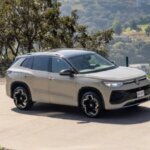 VW Tiguan vs Skoda Kodiaq: Which SUV Should We Choose?
The Tiguan also makes life easier when fitting bulky child seats. More room around the rear doors and seating area means less contortion when securing children.
Our backs tend to appreciate these things long before our brains admit they matter.
Volkswagen Tiguan vs T-Roc Boot Space
This round isn't particularly close.
Volkswagen quotes 475 litres for the current T-Roc's luggage compartment. The Tiguan can provide up to 652 litres with its rear bench adjusted forward, while Volkswagen lists up to approximately 1,650 litres when the rear seats are folded on applicable standard Tiguan versions.
The T-Roc's 475-litre figure is still impressive for a vehicle of its size.
It's enough for normal grocery runs, airport luggage or a couple's weekend getaway without playing Tetris with every bag.
The Tiguan goes further.
That additional cargo volume becomes useful for pushchairs, sports equipment, camping gear, large suitcases or simply the astonishing amount of stuff children seem capable of generating.
Is the T-Roc Boot Big Enough for a Family?
For many small families, absolutely.
Its 475 litres are considerably more useful than what we find in many conventional hatchbacks.
But family requirements tend to expand.
Babies become toddlers. Toddlers acquire bicycles. Holidays become road trips. Suddenly every spare cubic centimetre matters.
If we're planning to keep the vehicle through several stages of family life, buying extra space now can prevent us from needing another vehicle later.
Volkswagen T-Roc vs Tiguan Design
This category is subjective, but the two models deliberately project different characters.
The T-Roc has traditionally emphasized style more heavily. Its shape mixes SUV proportions with coupe-like visual touches, giving it a sportier, more youthful presence.
The latest generation continues that philosophy while becoming larger and more refined.
The Tiguan looks more mature.
It still has plenty of visual presence, especially in sportier specifications, but practicality dictates more of its proportions. Instead of trying to look playful, it presents itself as a sophisticated family SUV.
Which approach works better?
That's like choosing between sneakers and leather boots. Both can look great; they simply belong to different wardrobes.
Which VW Looks Sportier?
We'd give that award to the T-Roc.
Its proportions make it appear lighter and more energetic.
The Tiguan becomes more aggressive in sport-focused trim levels and with larger alloy wheels, but its underlying mission remains practicality.
Interior Quality and Cabin Design
This comparison has become increasingly interesting as Volkswagen modernizes both models.
New-generation Volkswagen interiors place greater emphasis on digital interfaces, large infotainment displays and cleaner dashboard layouts.
The Tiguan benefits from features and technologies that Volkswagen has progressively brought down from more premium models. Volkswagen has even offered its sophisticated IQ.LIGHT HD matrix headlamp technology, derived from the larger Touareg, on the current Tiguan depending on configuration.
The T-Roc also feels substantially more modern than earlier versions.
So the question isn't simply which cabin looks newer.
It's about atmosphere.
The T-Roc feels compact and driver-focused. The Tiguan gives us a broader, airier environment that feels better suited to longer journeys.
Technology and Infotainment
Equipment depends heavily on trim and market, so comparing model names alone can be misleading.
A generously equipped T-Roc may contain more desirable technology than an entry-level Tiguan.
That's why we'd always compare actual specifications rather than assuming the larger car automatically gets everything.
Depending on model and market, buyers may encounter digital instrument clusters, large central infotainment displays, smartphone connectivity, parking assistance, driver-assistance systems, configurable ambient lighting and premium lighting technology.
Our advice is simple: prioritize the features we genuinely use.
A giant options list looks wonderful in a brochure. Six months later, most of us repeatedly use the same ten functions.
Volkswagen Tiguan vs T-Roc Engines
Engine availability changes by country and model year, so there isn't one universal answer.
The broader difference is more useful.
The T-Roc's smaller dimensions naturally suit efficient petrol and electrified powertrains intended for everyday driving. The Tiguan's range has historically been broader, reflecting its role as a heavier, more versatile family SUV.
Current-generation Tiguan offerings in European markets have included petrol, mild-hybrid and plug-in hybrid technology, depending on country and specification.
We shouldn't choose based exclusively on horsepower.
How we drive matters more.
Someone covering mainly urban mileage has different priorities from someone travelling hundreds of motorway kilometres every week.
You might be interested in this content. Hyundai Kona Reliability Canada: Is It a Dependable SUV?
Which Engine Should You Choose?
A sensible process looks like this:
- Choose a modest petrol or mild-hybrid configuration if most driving involves ordinary commuting and mixed roads.
- Consider stronger outputs if the vehicle regularly carries several passengers or spends substantial time on fast roads.
- Consider electrified versions where charging access, local taxation and driving patterns make them financially sensible.
- Compare insurance and servicing costs before automatically choosing the most powerful trim.
- Check the exact market specification because engine availability differs considerably between countries.
More power is enjoyable, but unused horsepower is rather like paying rent for a spare bedroom nobody enters.
Volkswagen Tiguan vs T-Roc Driving Experience
The T-Roc's compact size shapes its character.
It generally feels more eager in urban environments, and changing direction takes less effort. There's simply less vehicle around us.
That can create a sense of agility even when we're driving at completely ordinary speeds.
The Tiguan trades some of that compact-car feeling for maturity.
Its larger footprint gives it the character we expect from a family SUV. Long motorway journeys, loaded trips and everyday passenger duties are closer to its natural habitat.
Which Is Better Around Town?
T-Roc.
That's its home turf.
The smaller dimensions simplify busy streets, parking garages and tight spaces. Drivers who spend 80% of their time in cities may wonder why they need the additional bulk of a Tiguan.
Which Is Better on Long Trips?
Tiguan.
Not because the T-Roc suddenly becomes unpleasant outside city limits—it doesn't—but because the Tiguan's greater passenger room and luggage capacity make extended journeys easier.
Imagine four adults travelling for a week.
The first hour probably feels similar in either car.
By hour five, those extra centimetres begin negotiating on the Tiguan's behalf.
Ride Comfort: Tiguan or T-Roc?
Wheel size and suspension specification can influence comfort enormously.
That's worth remembering because drivers sometimes blame the entire vehicle when their enormous optional wheels are partly responsible for a firmer ride.
Broadly, the Tiguan's mission favors relaxed family travel, giving it a more substantial character.
The T-Roc feels more compact.
Neither interpretation is automatically superior. Some drivers prefer a vehicle that feels closely connected to the road; others want something that seems to iron the road flat.
Try both on imperfect pavement rather than judging them exclusively on a smooth dealership route.
Volkswagen Tiguan vs T-Roc Fuel Economy
The smaller T-Roc has a natural theoretical advantage.
Less vehicle usually means less weight and less energy required to move it, although actual fuel economy depends on engine, transmission, drivetrain, wheels, traffic and driving style.
That final variable matters enormously.
A carefully driven Tiguan can easily consume less fuel than a T-Roc driven like every traffic light is the starting grid at Silverstone.
When comparing particular versions, use official consumption data for the exact engine and then examine owner experiences for realistic expectations.
Which Is Cheaper to Run?
We'd generally expect a comparable T-Roc to be the cheaper vehicle to own.
Its lower position in the range can translate into a lower purchase price, and smaller or less powerful configurations may potentially reduce fuel, tyre and insurance expenses.
But trim choice can reverse that equation quickly.
A fully loaded high-performance T-Roc can easily become a more expensive proposition than a modestly equipped Tiguan.
Compare the cars you're actually considering—not imaginary base models.
Tiguan vs T-Roc for Families
Here's where our recommendation becomes clearer.
If we're buying specifically as a primary family car, the Tiguan has the advantage.
More luggage room alone is a major reason. Volkswagen's published figures show the difference clearly: up to 652 litres in the Tiguan versus 475 litres in the current T-Roc.
That's up to 177 additional litres.
For a single person, those litres might remain empty most weeks.
For parents, they somehow disappear immediately.
The Tiguan also makes more sense if we regularly transport grandparents, teenagers or adult passengers in the rear.
When Does the T-Roc Make More Sense for a Family?
The T-Roc remains an excellent option when the family is small and most driving happens locally.
One child?
Usually plenty.
Two young children with minimal long-distance travel?
Still perfectly realistic.
You might be interested in this content.Hyundai Kona Trim Levels: Complete Guide to Choosing the Right KonaAdd a large stroller, two child seats, a dog and holiday luggage, though, and the Tiguan begins looking increasingly persuasive.
T-Roc vs Tiguan for Singles and Couples
Now the balance swings sharply toward the T-Roc.
A household of one or two people may gain little from carrying around the Tiguan's additional dimensions every day.
The T-Roc provides substantial boot space for its footprint, looks stylish, handles urban environments more naturally and retains enough passenger capacity for friends or relatives.
That's arguably its sweet spot.
It gives us SUV styling and practicality without making us feel as if we've bought a family vehicle five years before needing one.
Volkswagen Tiguan vs T-Roc Safety
Both belong to a modern Volkswagen ecosystem where driver-assistance technologies play an increasingly prominent role.
Exact equipment varies by specification, so we'd resist claims that every example contains the same systems.
When shopping, compare features such as automatic emergency braking, lane assistance, blind-spot monitoring, adaptive cruise functionality, parking assistance and advanced lighting according to the specific vehicle.
The key question shouldn't simply be, "Which has more safety technology?"
It should be, "Which version includes the safety features important to us?"
A feature hidden in an optional package doesn't protect anyone unless we've actually bought it.
Tiguan vs T-Roc Reliability and Maintenance
These vehicles share Volkswagen engineering philosophies and, depending on generation and powertrain, may also share various mechanical or electronic components.
Reliability therefore shouldn't be treated as a simple badge-level contest between Tiguan and T-Roc.
Configuration matters.
Engine choice matters.
Transmission matters.
Maintenance history matters enormously when we're buying used.
A beautifully maintained higher-mileage vehicle can be a much wiser purchase than a neglected low-mileage example wearing shinier paint.
For used examples, we'd concentrate on service documentation, fluid maintenance, warning lights, electronic functions, tyre wear and evidence of accident repairs.
Also check recall and service-campaign history using the VIN and the appropriate Volkswagen service network or national database.
Which One Offers Better Value?
Value isn't the same thing as cheapness.
The T-Roc can offer better value to someone who doesn't need the Tiguan's room. Paying extra for space we rarely use is hardly a bargain.
The Tiguan can offer much better value to a family that would otherwise outgrow the T-Roc.
This is where buyer profiles matter more than spreadsheet comparisons.
Ask one question:
What will frustrate us more in three years—driving a vehicle slightly larger than necessary, or wishing we'd bought more space?
Our answer tells us a lot.
Volkswagen Tiguan vs T-Roc Used: Which Should We Buy?
The used market changes the equation.
Depreciation narrows the original price difference, sometimes allowing buyers to purchase a larger Tiguan for surprisingly close money.
Don't automatically jump at that opportunity.
A bigger vehicle still carries bigger-vehicle expenses.
Tyres may cost more. Higher-output engines can use more fuel. Insurance may differ. More sophisticated specifications can introduce additional systems that become expensive when repairs eventually arrive.
Meanwhile, a clean used T-Roc may provide everything we need while leaving more money in the budget.
Condition beats badge hierarchy.
Every time.
What Should We Check Before Buying Used?
Service history comes first.
We'd also examine cold-start behavior, transmission operation, infotainment functions, parking sensors, cameras, air-conditioning, warning lights and abnormal tyre wear.
Test-drive the vehicle long enough for everything to reach operating temperature.
Five minutes around the dealer's block tells us approximately nothing.
Don't Forget the Exact Engine
Two Tiguan models parked beside each other can produce very different ownership experiences depending on engine, transmission and drivetrain.
The same applies to the T-Roc.
Research the specific powertrain code or engine version rather than searching for generic statements such as "Is the Tiguan reliable?"
You might be interested in this content.Hyundai Kona Trunk Space: Complete Cargo and Boot GuideSpecific questions produce much better answers.
Who Should Buy the Volkswagen T-Roc?
Choose the T-Roc when compactness matters more than maximum practicality.
It's particularly compelling for city drivers, couples, individuals and smaller families.
We'd choose it over the Tiguan when our lifestyle involves difficult parking, crowded streets and relatively light luggage requirements.
It doesn't feel like the compromise choice.
That's important.
The T-Roc isn't merely a Tiguan with pieces removed. Its smaller dimensions are part of its appeal.
There's something refreshing about driving a vehicle that's exactly as large as we need.
Who Should Buy the Volkswagen Tiguan?
Choose the Tiguan when versatility comes first.
Families should pay particular attention.
The larger cargo compartment, more generous passenger accommodation and more substantial road-trip character make it the stronger single-car household solution.
It's also better suited to owners whose needs fluctuate.
Monday might involve a solo commute.
Friday involves four passengers.
Saturday brings sports equipment.
Sunday brings furniture from a store that definitely looked smaller before we paid for it.
The Tiguan handles that unpredictability more gracefully.
Volkswagen Tiguan vs T-Roc: Pros and Cons
The T-Roc's biggest strengths are its manageable dimensions, large boot relative to its footprint, stylish appearance and suitability for urban driving. Its weaknesses appear when we consistently ask it to perform bigger-family duties.
The Tiguan counters with substantially more luggage capacity, stronger family practicality and better suitability for long journeys. The trade-off is simple: we're driving more vehicle every day.
Interestingly, neither vehicle wins universally.
That's exactly why Volkswagen can sell both without one making the other irrelevant.
They answer different versions of the same question.
Which Is Better: Volkswagen Tiguan or T-Roc?
For the broadest range of buyers, the Volkswagen Tiguan is the more capable all-rounder.
Its additional space makes it easier to recommend as a primary family car, and its maximum luggage capacity gives owners considerably more flexibility. Volkswagen quotes up to 652 litres for applicable Tiguan configurations compared with 475 litres in the new T-Roc.
However, capability isn't synonymous with suitability.
The Volkswagen T-Roc is arguably the smarter purchase for people who don't need the Tiguan's extra space.
It's shorter, easier to manage and still surprisingly practical.
We shouldn't buy our car for the biggest journey we might possibly make once every two years. We should buy it for the life we actually live.
Volkswagen Tiguan vs T-Roc: Our Final Verdict
The Volkswagen Tiguan vs T-Roc contest doesn't produce one universal champion.
It produces two winners for two different buyers.
We'd choose the T-Roc for city living, commuting, couples and smaller households. Its compact footprint makes everyday driving easier, while the 475-litre luggage compartment means practicality hasn't been sacrificed on the altar of style.
We'd choose the Tiguan for families, frequent road trips, adult rear passengers and anyone regularly carrying bulky cargo. The current model's ability to offer up to 652 litres of luggage capacity gives it a clear practical advantage.
The easiest way to decide is to forget horsepower, trim badges and glossy brochures for a moment.
Look at the driveway.
Look at the people who will regularly occupy the seats.
Look at what normally goes into the boot.
If we regularly fill every available corner, get the Tiguan.
If half the Tiguan would spend its life carrying fresh air, get the T-Roc.
Sometimes the best SUV isn't the biggest or most expensive one.
It's simply the one that fits.
Frequently Asked Questions
Is a Volkswagen Tiguan bigger than a T-Roc?
Yes. The current Tiguan is noticeably larger. Volkswagen lists the present Tiguan at approximately 4,539 mm long, while the latest-generation T-Roc is around 4,373 mm long, making the Tiguan roughly 166 mm longer.
Which has more boot space, the Tiguan or T-Roc?
The Tiguan. Volkswagen quotes up to 652 litres of luggage space for the standard Tiguan depending on rear-seat positioning, versus 475 litres for the current T-Roc.
Is the Volkswagen T-Roc good for a family?
Yes, particularly for smaller families. Its 475-litre luggage compartment is generous for a compact crossover, and the latest generation provides improved passenger accommodation. Families frequently carrying large pushchairs, several suitcases or lots of sports equipment may nevertheless prefer the Tiguan.
You might be interested in this content.How Long Is Volkswagen Tiguan? Full Size and Dimensions GuideIs the T-Roc easier to drive than the Tiguan?
For urban driving, we'd generally say yes. Its shorter body makes maneuvering and parking easier. The Tiguan remains manageable, but its additional size becomes more noticeable in narrow streets and small parking spaces.
Should I buy a Volkswagen Tiguan or T-Roc?
Buy the T-Roc if you prioritize compact dimensions, city usability and enough practicality for everyday life. Buy the Tiguan if passenger space, luggage capacity and family versatility are more important. Neither is inherently better—the right choice depends on how much space you'll regularly use.
Leave a Reply