
Nissan Kicks vs Qashqai: Which SUV Is the Better Choice?

Choosing between the Nissan Kicks vs Qashqai can feel a little like choosing between a compact city apartment and a slightly larger suburban home. Both deliver the essentials, both carry the Nissan badge, and both fit comfortably into the crossover lifestyle. Yet once we look beneath the surface, their personalities become surprisingly different.
The Kicks generally focuses on affordability, maneuverability, fuel economy, and straightforward everyday driving. The Qashqai sits farther up Nissan's crossover ladder, bringing more substantial road manners, a broader powertrain range in markets where it is sold, and a more mature cabin experience.
There's an important catch, though: the Kicks and Qashqai are not offered in identical forms worldwide. Nissan sells different engines, drivetrains, trim levels, and even generations depending on the country. For example, the current Canadian Kicks uses a 2.0-litre gasoline engine, while the UK-market Qashqai is offered with mild-hybrid and e-POWER configurations. So rather than mixing specifications as if these vehicles came from one showroom, we'll compare their underlying strengths and clearly identify where current-market figures are relevant.
Let's figure out which Nissan actually makes more sense for the way we drive.
- Nissan Kicks vs Qashqai at a Glance
- Nissan Kicks vs Qashqai Size: How Much Bigger Is the Qashqai?
- Exterior Design: Youthful Kicks or Sophisticated Qashqai?
- Interior Comparison: Nissan Kicks vs Qashqai
- Passenger Space: Which Nissan Is Better for Families?
- Nissan Kicks vs Qashqai Cargo Space
- Engine and Performance: Kicks vs Qashqai
- Fuel Economy: Which One Saves More Fuel?
- Ride Comfort and Refinement
- Handling and Driving Experience
- All-Wheel Drive: Nissan Kicks vs Qashqai
- Towing: Qashqai Wins Easily
- Technology and Driver Assistance
- Safety: Which One Should We Choose?
- Price and Value: Why the Kicks Makes So Much Sense
- Running Costs and Ownership
- Nissan Kicks vs Qashqai Reliability
- Nissan Kicks vs Qashqai for City Driving
- Nissan Kicks vs Qashqai for Families
- Nissan Kicks vs Qashqai for Long Road Trips
- Nissan Kicks vs Qashqai for First-Time Buyers
- Which Nissan Holds the Better Overall Value?
- Nissan Kicks vs Qashqai: Pros and Cons
- Which Should We Buy: Nissan Kicks or Qashqai?
- Final Verdict: Kicks for Simplicity, Qashqai for Versatility
- Frequently Asked Questions
Nissan Kicks vs Qashqai at a Glance
The easiest way to understand these two SUVs is to consider their missions.
The Nissan Kicks is primarily a small crossover. It's designed for drivers who want SUV-like seating and versatility without the bulk, expense, or thirst of a larger vehicle.
The Nissan Qashqai, meanwhile, occupies a more substantial compact-crossover position in markets such as the UK and Europe. It usually feels closer to a traditional family SUV than the Kicks does.
| Category | Nissan Kicks | Nissan Qashqai |
|---|---|---|
| Basic character | Small, urban-friendly crossover | Larger, more family-oriented crossover |
| Best environment | City and suburban driving | Mixed city, highway and family use |
| Purchase philosophy | Value and simplicity | Comfort, refinement and technology |
| Parking | Easier | Still manageable, but larger |
| Performance | Adequate and economical | Generally stronger options available |
| Hybrid availability | Market-dependent | Mild hybrid and e-POWER in the UK |
| Cabin feel | Practical and youthful | More mature and upscale |
| Best for | Singles, couples, commuters | Families and frequent road-trippers |
That doesn't automatically make the Qashqai better. Paying for extra SUV can be pointless if we're never going to use it.
Nissan Kicks vs Qashqai Size: How Much Bigger Is the Qashqai?
Current specifications illustrate how close these vehicles have become while still occupying different positions.
Nissan Canada's 2026 Kicks measures 4,365 mm long, 1,800 mm wide and 1,630 mm high, with a 2,656-mm wheelbase. Nissan UK's current Qashqai brochure lists it at 4,425 mm long, 1,835 mm wide and 1,625 mm high, with a 2,665-mm wheelbase.
Those numbers reveal something interesting: the latest Kicks has grown significantly compared with earlier versions.
The Qashqai is still longer and wider, but we're no longer comparing a tiny crossover with a giant SUV. They live relatively close together dimensionally.
Which Is Easier to Drive in the City?
The Kicks gets our vote here.
Its slightly narrower footprint can make squeezing between parked cars, entering tight garages, and navigating crowded streets less stressful.
Anyone who regularly parallel-parks knows that a few centimeters can suddenly feel like several feet when another vehicle is waiting impatiently behind us.
The Kicks was essentially born for this environment.
The Qashqai isn't cumbersome by SUV standards, but it carries more visual and physical mass. We'd rather have that extra substance on a motorway than while hunting for the last parking space outside a busy supermarket.
Which Feels More Like a Proper SUV?
The Qashqai.
Its broader body, greater overall substance, and driving position give it the more traditional compact-SUV personality.
The Kicks still delivers the elevated seating position crossover buyers appreciate, but it remains closer to a nimble urban vehicle in spirit.
Exterior Design: Youthful Kicks or Sophisticated Qashqai?
Style is subjective, but these two Nissans don't whisper the same message.
The Kicks tends to look energetic. Bold lines, contrasting roof treatments on certain trims, strong wheel designs, and youthful detailing make it the more playful choice.
The Qashqai looks more mature.
Its proportions are restrained enough for the school run but assertive enough that it doesn't disappear in a corporate parking lot. Recent versions use sharp lighting, a prominent grille, and wheel sizes that can reach 20 inches depending on trim in the UK.
Think sneakers versus leather boots. One feels light and casual; the other brings a little more presence.
Interior Comparison: Nissan Kicks vs Qashqai
Step inside and the difference in philosophy becomes clearer.
The latest Kicks has moved well beyond the basic cabins associated with inexpensive subcompact SUVs. Depending on trim and market, features can include large digital displays, wireless smartphone integration, a Bose audio system, wireless charging, heated seats, and modern driver-assistance technology.
For the Canadian 2026 model, Nissan lists a 12.3-inch NissanConnect touchscreen even among key equipment, while upper specifications can add further digital and convenience upgrades.
The Qashqai approaches the cabin from a more premium angle.
Nissan UK's current model offers features such as Google built-in on selected grades, integrating services including Google Maps and Google Assistant. It feels designed for buyers who expect their SUV to behave almost like a rolling extension of their smartphone and living room.
Which Interior Feels More Expensive?
Generally, the Qashqai.
Its positioning allows Nissan to spend more attention on materials, insulation, seat design, and cabin ambiance.
That's not a criticism of the Kicks. In fact, the Kicks can feel impressively modern considering its place in Nissan's lineup.
But there's a difference between modern-looking and premium-feeling.
The Kicks wins points for visual punch. The Qashqai typically wins for overall sophistication.
What About Infotainment?
Both can be well equipped, although exact features depend heavily on model year and country.
Current examples demonstrate how close the technology battle has become. Large displays and wireless phone connectivity are available in the Kicks, while the Qashqai increasingly integrates connected-car features and Google-based services.
For most buyers, either should cover navigation, music, calls, and everyday connectivity comfortably.
Passenger Space: Which Nissan Is Better for Families?
Here's where dimensions only tell half the story.
The latest Kicks has become impressively roomy. Nissan Canada lists rear legroom of about 876 mm for the 2026 model, and its cabin is designed around five-passenger practicality.
Still, if our normal passenger list includes teenagers, adults, child seats, backpacks, and enough snacks to survive a minor apocalypse, we'd gravitate toward the Qashqai.
Its broader family-SUV mission tends to make it better suited to repeated rear-seat use.
Kicks Rear Seats
For occasional adult passengers, children, or a small family, the Kicks can work perfectly well.
The main advantage is efficiency of packaging. Nissan has squeezed an impressive amount of usable space into a compact exterior.
That's exactly what a good urban crossover should do.
You might be interested in this content.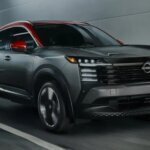 Nissan Kicks vs Kicks Play: Which One Should You Buy?
Qashqai Rear Seats
The Qashqai feels more natural when the second row is occupied regularly.
Entry, perceived width, seating comfort, and overall cabin atmosphere make it the vehicle we'd choose for longer family trips.
If rear passengers only appear twice a month, however, buying the larger SUV simply for them starts looking like buying an eight-seat dining table for two people.
Nissan Kicks vs Qashqai Cargo Space
Cargo figures require caution because measuring standards vary between countries, and comparing figures from different Nissan divisions isn't perfectly apples-to-apples.
Still, current official specifications give us useful context.
The Canadian 2026 Kicks lists up to 849.5 litres of cargo capacity behind the second row and roughly 1,699.6 litres with the rear seats folded, using Nissan Canada's measurement methodology.
The current UK Qashqai brochure lists 455 to 504 litres behind the second row and as much as roughly 1,447 litres with seats folded, under its European measurement methodology.
Those numbers should not be used to conclude that the Kicks necessarily has a physically larger boot. Different regional measurement systems can produce dramatically different advertised volumes.
The practical takeaway is simpler: both make good use of their footprints, while the Qashqai's wider, more family-oriented body may be preferable for bulky everyday loads.
Engine and Performance: Kicks vs Qashqai
This is one of the biggest differences.
The Kicks typically prioritizes straightforward, economical performance.
For example, the 2026 Canadian Kicks uses a 2.0-litre four-cylinder engine producing 141 hp and 140 lb-ft of torque, paired with Nissan's Xtronic CVT.
That isn't sports-car territory.
Nor is it supposed to be.
Press the accelerator and the Kicks focuses on getting us to work, the grocery store, or the airport efficiently rather than pinning us into the seat.
The Qashqai offers a much broader performance story in its current UK form.
Qashqai Mild Hybrid
The current UK lineup includes a 1.3-litre mild-hybrid petrol engine, with Nissan listing outputs including 140 PS and 158 PS depending on configuration.
It delivers conventional internal-combustion driving with electrified assistance rather than transforming the driving experience completely.
Qashqai e-POWER
This is where things get interesting.
Nissan's e-POWER system uses the gasoline engine to generate electricity while the wheels are driven electrically. The result aims to provide some of the smooth, immediate response associated with an EV without requiring external charging.
Current UK specifications list the latest Qashqai e-POWER at as much as 205 PS in Sport Mode, with acceleration from 0 to 62 mph quoted as quick as 7.6 seconds in that mode.
Against a conventional Kicks, that's a very different personality.
Which Is Faster?
Qashqai, particularly in e-POWER form.
Which Is Simpler?
The naturally aspirated Kicks powertrain is conceptually more straightforward.
For buyers who couldn't care less about acceleration numbers and just want predictable transportation, simplicity has its own charm.
Fuel Economy: Which One Saves More Fuel?
This comparison gets complicated because the vehicles are tested under different regulatory cycles around the world.
The 2026 Canadian Kicks is officially listed at approximately 8.1 L/100 km city, 6.6 L/100 km highway and 7.4 L/100 km combined in a front-wheel-drive configuration.
The latest UK Qashqai e-POWER is quoted at roughly 4.3–4.5 L/100 km combined under WLTP testing, depending on grade and specification.
We shouldn't directly compare those laboratory numbers because Canadian and European testing procedures differ.
Conceptually, though, the distinction is clear.
The Kicks achieves good economy through a relatively light body, conventional gasoline engine, and CVT.
The Qashqai e-POWER attacks the problem with electrification.
Which Is Better for Urban Fuel Economy?
An e-POWER Qashqai can be particularly appealing in stop-and-go environments because electric propulsion fits that driving pattern beautifully.
A conventional Kicks remains attractive because we're getting respectable efficiency without stepping into a more sophisticated—and usually more expensive—hybrid system.
Ride Comfort and Refinement
This is an area where spec sheets become almost useless.
Two vehicles can have similar dimensions but feel worlds apart from behind the wheel.
The Kicks tends to communicate its lightweight, urban-focused character. It's easy to place on the road and generally feels eager to change direction.
The Qashqai carries itself with greater maturity.
On longer journeys, we'd expect its additional refinement to matter more than a few horsepower or centimeters of cargo space. Road noise, ride composure, seat comfort, and the way the vehicle settles at speed become increasingly important after two or three hours behind the wheel.
If we're commuting 15 minutes across town, the difference matters less.
If we're driving hundreds of motorway miles every month, Qashqai makes a stronger case.
Handling and Driving Experience
Nobody buys either vehicle because they're hunting Nürburgring lap records, and that's completely fine.
The Kicks' advantage is agility.
It feels more at home slipping through small gaps and responding quickly to urban traffic.
The Qashqai feels more planted.
You might be interested in this content.Nissan Kicks vs Hyundai Venue: Which Small SUV Is Better?Its extra substance gives us a greater sense of stability at speed, while electrified versions can deliver stronger immediate acceleration.
Which Is Better for a New Driver?
The Kicks is particularly appealing.
Compact dimensions, approachable performance, good visibility, and available driver-assistance equipment create a reassuring combination.
Which Is Better for Highway Driving?
We'd choose the Qashqai.
Its refinement, stronger powertrain choices, and family-oriented chassis are better suited to frequent high-speed cruising.
All-Wheel Drive: Nissan Kicks vs Qashqai
Drivetrain availability depends strongly on the country and model year.
The latest Canadian Kicks offers available Intelligent AWD on selected trims, along with an available Snow Mode.
Interestingly, Nissan UK's current Qashqai specifications list the current mild-hybrid and e-POWER configurations as front-wheel drive.
This is a good example of why we shouldn't assume the larger vehicle automatically offers more traction options.
If AWD is essential because we regularly face snow, steep driveways, or slippery rural roads, check the exact locally sold version rather than choosing purely by model name.
Towing: Qashqai Wins Easily
Planning to tow?
This becomes a short conversation.
Nissan Canada specifically states that the current Kicks is not rated for towing and is not recommended for pulling a trailer.
The UK Qashqai, by contrast, has official braked towing capacities that vary by powertrain. Nissan's current brochure lists capacities ranging from 750 kg for e-POWER to as much as 1,800 kg for certain mild-hybrid configurations.
So if towing is even moderately important, the Qashqai is the obvious contender—provided the exact local model is appropriately rated.
Technology and Driver Assistance
Both models demonstrate Nissan's push toward making advanced technology available beyond luxury vehicles.
Depending on trim, Kicks equipment can include digital instrumentation, smartphone integration, surround-view monitoring, advanced safety systems, and premium Bose audio.
The Qashqai goes a step further in selected trims with integrated connected services and Google built-in.
Does the Qashqai Feel More High-Tech?
Usually, yes.
But there's an important distinction between technology we enjoy and technology we actually use.
If we spend 90% of every journey listening to Spotify through Apple CarPlay, paying significantly more for layers of additional digital functionality may not improve our life much.
The Kicks covers the fundamentals surprisingly well.
Safety: Which One Should We Choose?
Rather than declaring one universally safer, we should compare specific model years in the country where we're shopping.
Crash-test protocols differ between organizations, and available safety equipment changes by trim.
Both modern Nissan crossovers can offer technologies designed to assist with collision avoidance, lane monitoring, parking, and driver awareness.
When comparing actual vehicles, we'd prioritize:
- Automatic emergency braking
- Blind-spot monitoring
- Rear cross-traffic alert
- Lane-departure or lane-keeping assistance
- Adaptive cruise control where available
- Surround-view cameras
- Current crash-test performance for the exact model year
A high trim with stronger active-safety equipment may be more attractive than simply buying the larger vehicle.
Price and Value: Why the Kicks Makes So Much Sense
This is the Kicks' secret weapon.
Its mission revolves around delivering the things most crossover owners actually use—five seats, decent cargo capacity, elevated seating, modern infotainment, available AWD in some markets, and respectable economy—without forcing us into a larger and more expensive vehicle.
That makes it exceptionally logical.
The Qashqai asks us to pay more because it gives us more: more refinement, broader performance possibilities, electrification in some markets, and a more upscale family-SUV experience.
When Is the Qashqai Worth Paying More For?
We'd justify the extra cost when:
- Rear-seat passengers travel regularly.
- Long-distance comfort matters.
- We want hybrid or e-POWER technology.
- Stronger acceleration is important.
- Towing is part of our lifestyle.
- Cabin refinement matters more than minimum purchase price.
- The vehicle will serve as the household's main family car.
If none of those really describe us, the Kicks starts looking like the smarter financial move.
Running Costs and Ownership
The Kicks generally benefits from being the simpler, smaller vehicle.
Smaller vehicles often mean less expensive tires, potentially lower fuel consumption than larger conventional SUVs, and a purchase price that leaves more money in our pocket before ownership even begins.
Qashqai operating costs vary dramatically depending on engine and trim.
A mild-hybrid model, for example, differs mechanically from e-POWER. Bigger wheels can also make replacement tires considerably more expensive.
Don't underestimate that last point.
A beautiful set of large wheels looks fantastic in a showroom, but tire replacement day has a way of restoring our appreciation for smaller rims.
Nissan Kicks vs Qashqai Reliability
Reliability is more nuanced than saying one model name is "reliable" and the other isn't.
Generation matters.
Engine matters.
Transmission matters.
Maintenance history matters enormously when we're buying used.
A well-maintained Qashqai with documented servicing can be a much safer purchase than a neglected Kicks, and vice versa.
You might be interested in this content.Nissan Kicks vs Hyundai Kona: Which Small SUV Wins?What Should We Check on a Used Kicks?
Pay attention to maintenance documentation, CVT behavior on applicable models, warning lights, suspension noises, electronics, air-conditioning operation, and signs of accident damage.
What Should We Check on a Used Qashqai?
Again, service history comes first. Then evaluate the exact engine and transmission fitted, listen for unusual suspension noises, test all electronics, check driver-assistance systems, and investigate any warning messages.
Hybrid and e-POWER versions deserve inspection by someone familiar with their technology if we're purchasing outside warranty coverage.
Never Compare Used Cars by Model Name Alone
Two eight-year-old Qashqais can live completely different lives.
One may have been serviced religiously and parked in a garage. The other might have spent years skipping oil changes while bouncing over potholes.
Condition often matters more than reputation.
Nissan Kicks vs Qashqai for City Driving
Winner: Kicks
This is where the Kicks' entire philosophy shines.
It's easy to maneuver, compact enough for urban parking, economical, practical, and less intimidating in crowded environments.
For commuting, school runs with one or two children, supermarket duty, and weekend errands, we're not sure most buyers actually need anything larger.
Nissan Kicks vs Qashqai for Families
Winner: Qashqai
Once the vehicle becomes the household workhorse, the equation changes.
Rear passengers, holiday luggage, long journeys, child seats, motorway driving, and sheer day-to-day abuse all favor the more substantial Qashqai.
The Kicks can certainly serve a small family.
The Qashqai simply gives that family more breathing room.
Nissan Kicks vs Qashqai for Long Road Trips
Winner: Qashqai
The Kicks can absolutely travel long distances. There's no imaginary wall around the city preventing it from entering the motorway.
But we'd choose the Qashqai for repeated cross-country journeys.
Why?
Because refinement compounds over time.
A slightly quieter cabin, stronger acceleration, more relaxed ride, and additional passenger comfort might seem insignificant on a 20-minute test drive. After six hours, those details become the entire story.
Nissan Kicks vs Qashqai for First-Time Buyers
Winner: Kicks
For someone moving into their first crossover, the Kicks has a compelling formula.
It's approachable rather than overwhelming.
It gives us much of the SUV experience without demanding that we accept the cost and physical size of a larger vehicle.
It's the automotive equivalent of buying exactly the amount of house we need instead of maintaining three empty bedrooms because they looked impressive during the viewing.
Which Nissan Holds the Better Overall Value?
This depends entirely on what "value" means.
If value means getting transportation, practicality, equipment, and SUV styling for the lowest sensible cost, Kicks wins.
If value means getting a more complete family SUV with refinement, stronger performance possibilities, and advanced electrified technology, Qashqai can justify its premium.
Cheap and good value are not always synonyms.
Expensive and overpriced aren't either.
Nissan Kicks vs Qashqai: Pros and Cons
Nissan Kicks Advantages
- Easier to maneuver in cities
- Usually cheaper to buy
- Sensible fuel economy
- Modern technology for its class
- Surprisingly useful passenger and cargo space
- Available AWD in some markets
- Good choice for commuters and first-time SUV buyers
Nissan Kicks Disadvantages
- Less refined than Qashqai
- Performance is more modest
- Not designed for towing in markets such as Canada
- Less appealing for frequent long-distance family travel
- Smaller, less substantial overall feel
Nissan Qashqai Advantages
- More mature family-SUV experience
- More refined cabin
- Stronger performance options
- Mild-hybrid and e-POWER technology in current UK models
- Better suited to motorway driving
- Towing capability on appropriately equipped models
- More upscale technology and interior ambiance
Nissan Qashqai Disadvantages
- Typically costs more
- Larger dimensions aren't as convenient in tight cities
- More sophisticated powertrains can mean more complexity
- High-spec versions can become expensive
- Some buyers simply won't use its additional capability
Which Should We Buy: Nissan Kicks or Qashqai?
Choose the Nissan Kicks if our priorities are affordability, easy parking, uncomplicated everyday driving, modern technology, and practical transportation.
Choose the Nissan Qashqai if we regularly transport a family, drive long distances, want stronger performance or electrified powertrain options, or simply prefer the feel of a more substantial SUV.
Here's the simplest way to decide.
If our week looks like commute, supermarket, gym, restaurant, repeat, the Kicks is probably enough.
If it looks more like school run, commute, motorway, grandparents, luggage, holiday, trailer, repeat, the Qashqai earns its extra size.
Final Verdict: Kicks for Simplicity, Qashqai for Versatility
The Nissan Kicks vs Qashqai debate doesn't have one universal winner because these SUVs solve different versions of the same problem.
The Kicks proves that we don't need a large vehicle to enjoy crossover practicality. Today's version is roomier, better equipped, and more capable than the inexpensive urban runabout its name once suggested. It makes a persuasive case for buying only as much SUV as we actually need.
The Qashqai goes farther. It feels more like a complete family vehicle, with greater refinement, stronger available performance, legitimate towing capability in certain configurations, and sophisticated electrified options such as e-POWER in markets where they're offered.
Our money would go toward the Kicks for urban commuting and value, while the Qashqai would be our pick for family life and frequent highway travel.
Sometimes the best car isn't the one with more of everything.
It's the one whose strengths match our Tuesday morning.
Frequently Asked Questions
1. Is the Nissan Qashqai bigger than the Nissan Kicks?
Yes, based on current Canadian Kicks and UK Qashqai specifications. The Kicks measures about 4,365 mm long and 1,800 mm wide, while the Qashqai is approximately 4,425 mm long and 1,835 mm wide. The size difference is smaller than it once was because the newer Kicks has grown substantially.
2. Is the Nissan Kicks or Qashqai better for a family?
We'd generally choose the Qashqai for a family because its more substantial cabin, stronger long-distance character, and broader powertrain capabilities better suit frequent passenger use. The Kicks remains a strong option for smaller families that mainly drive in urban areas.
3. Which is more fuel-efficient, Nissan Kicks or Qashqai?
It depends on powertrain and market. The Canadian 2026 Kicks is rated at 7.4 L/100 km combined in the front-wheel-drive configuration, while current UK Qashqai e-POWER versions achieve much lower official WLTP consumption figures. Because Canada and Europe use different testing procedures, those numbers shouldn't be compared directly.
You might be interested in this content. Hyundai Kona Size Comparison: Dimensions, Space, and How It Measures Up
4. Can the Nissan Kicks tow like the Qashqai?
Not in current Canadian specification. Nissan Canada says the Kicks isn't rated or recommended for trailer towing. Current UK Qashqai variants have official braked towing ratings ranging from 750 kg to 1,800 kg depending on powertrain. Always confirm the rating for the exact vehicle sold in your country.
5. Is the Nissan Qashqai worth the extra money over the Kicks?
It can be. The Qashqai makes more sense if we value stronger performance, greater refinement, family usability, towing capability, or advanced electrified powertrains. If we mainly need an affordable crossover for everyday urban driving, the Kicks will often deliver better value.
Leave a Reply